
The Louisiana Supreme Court Amends Rule XIX to Specify JLAP
On November 21, 2019, the Louisiana Supreme Court issued an order amending Rule XIX, Section 24E3 to specify that in lawyer disciplinary matters JLAP is the path through which respondents must pass to be reinstated or readmitted in cases wherein substance use disorders are a causative factor in misconduct.
The amendment reflects recommendations made by the national experts in the 2015 JLAP Performance Audit. It is also a straightforward codification of thirty years of Louisiana Supreme Court jurisprudence endorsing JLAP, beginning with the watershed case Louisiana State Bar Association vs. Arthur F. Dumaine, 550 So.2d 1197 (La. 1989) wherein the Court ordered JLAP to provide the Court with expert, independent, objective and reliable data regarding the diagnosis, treatment and recovery of respondents in substance abuse cases.
JLAP is recognized nationally as a leading program and it continues to generate unprecedented 95% no-relapse success rates on average. The Court’s amendment of Rule XIX, Section 24E3 will not only ensure that the public is appropriately protected from the […]
Study Provides More Evidence of Behavioral, Biological Similarities Between Compulsive Overeating and Drug Addiction
 Does yo-yo dieting drive compulsive eating? There may be a connection.
According to BUSM researchers the chronic cyclic pattern of overeating followed by undereating, reduces the brain’s ability to feel reward and may drive compulsive eating. This finding suggests that future research into treatment of compulsive eating behavior should focus on rebalancing the mesolimbic dopamine system–the part of the brain responsible for feeling reward or pleasure.
An estimated 15 million people compulsively eat in the U.S. It is a common feature of obesity and eating disorders, most notably, binge eating disorder. People often overeat because it is pleasurable in the short term, but then attempt to compensate by dieting, reducing calorie intake and limiting themselves to “safe”, less palatable food. However, diets often fail, causing frequent “relapse” to overeating of foods high in fat and sugar (palatable foods).
“We are just now beginning to understand the addictive-like properties of food and how repeated overconsumption of high sugar – similar to taking drugs – may affect […]
Variety.com – The Recovery Issue

Prominent entertainment figures offer insights on navigating a sober life in Hollywood
Redefining Addiction. Reimagining Solutions.
By Paul Earley, MD and Yngvild Olsen, MD, MPH
Words matter. When it comes to addiction medicine, stigmatizing language and misunderstood terminology may keep some people from seeking effective care, leave families poorly equipped to support their loved ones, and drive policymakers to make counterproductive, even harmful, policy.
In 2011, the American Society of Addiction Medicine (ASAM) — the nation’s largest organization representing medical professionals who specialize in addiction prevention and treatment — set out to revise the society’s definition of addiction. This task was not easy given the complexity and stigma surrounding substance use and the term itself. At a time when the public had limited understanding and acceptance of addiction as a chronic brain disease, ASAM’s revised definition focused heavily on brain circuitry.
Over the past decade, however, more families, policymakers, and […]
JLAP Welcomes ABA Young Lawyers to the Big Easy
The ABA Young Lawyers Division presented the 2019 Fall Conference: Your Practice, Your Future, October 3 – 5, 2019 at the Sheraton in New Orleans. This conference brought people together from across the legal community to offer outstanding training on advancing justice.
JLAP’s Executive Director, Buddy Stockwell, spoke on Wellness and Well-Being in the Legal Profession, noting that it will be the Young Lawyers that will change the culture, making the practice of law more healthy.

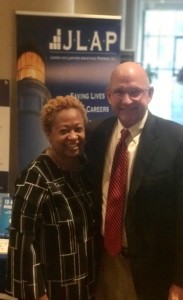 Donna Nesbit, ABA Director, Operations and Meetings – Early Career Strategy and Buddy Stockwell, JLAP Executive Director
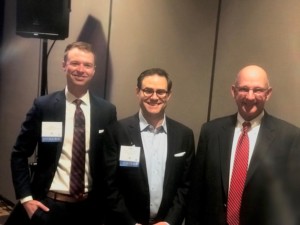 Christopher L. Brown, J. Logan Murphy & Buddy Stockwell
October 10th is National Law Students’ Mental Health Day
Law is a challenging discipline that involves the ability to analyze, reason, and communicate. The study and practice of law is rigorous and often stressful, however, a law degree can open many doors to a rewarding career in business, practice, government, teaching and public service.
For those law students struggling with issues of depression, anxiety, drug addiction or alcoholism or other mental issues, the JLAP is here to help. We offer a full range of resources and solutions to help you manage your issues in the short and long term. Every service provided through the JLAP is 100% confidential and 100% free.